Tech-driven pharma ingredients
Ingredient sourcing platform
Regulatory compliance platform
Specialized excipients developed to maintain stability, sterility, and compatibility in injectable formulations, ensuring safety and efficacy in every dose.
Comprehensive solutions supporting every stage of biologics development—formulated for purity, process efficiency, and superior therapeutic performance.
High-purity amino acid excipients engineered to enhance formulation stability, solubility, and bioavailability across a wide range of dosage forms.
Pharma-grade excipients designed with low endotoxin levels to support consistent quality and performance throughout vaccine formulation and production.
A trusted range of plasma-derived materials, Manufactured to meet global standards of purity and compliance.
Pharmaceutical-grade excipients that adhere to leading pharmacopeial monographs, ensuring regulatory readiness and uncompromised quality for global markets.
We collaborate with R&D labs on diverse product developments, transforming innovative ideas into ingredients that meet global quality and regulatory standards.
Expand your global reach with Clyzo’s advanced technology solutions. Maximize capacity utilization, streamline tech transfers, and bring new projects to market faster and more efficiently.
27-07-2026
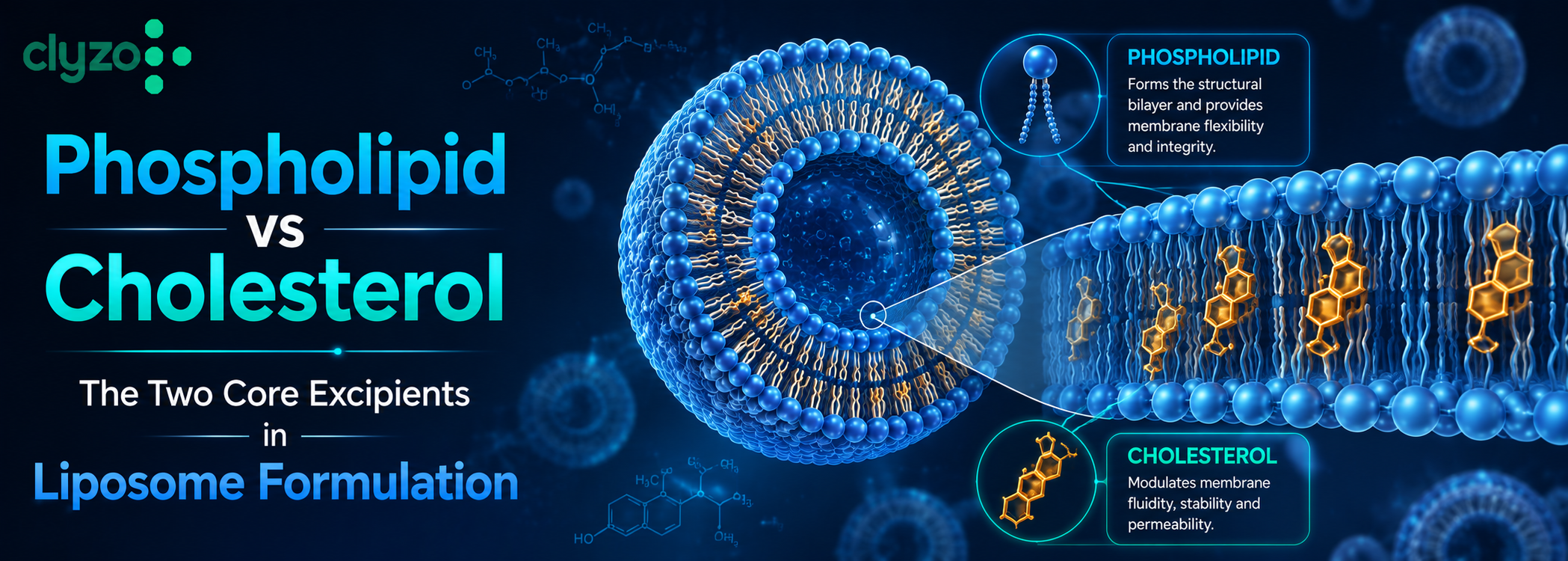
Almost every liposome, whether it carries a chemotherapy drug, an antifungal, an mRNA payload, or a nutraceutical compound, is built from the same two foundational excipients: phospholipids and cholesterol. They are often mentioned together, but they do fundamentally different jobs inside the bilayer. Understanding the distinction is essential for anyone formulating, sourcing, or troubleshooting a liposomal product.
This article breaks down what each excipient does, how they interact, and why getting their ratio right is one of the most important decisions in liposome formulation design.
Phospholipids are the primary structural material of a liposome. They are amphipathic molecules, meaning each one has a hydrophilic (water attracting) head group and two hydrophobic (water repelling) fatty acid tails. When phospholipids are dispersed in water, they spontaneously arrange themselves into a bilayer, with the hydrophilic heads facing outward toward the water on both sides and the hydrophobic tails facing inward, away from water. This self assembly is what forms the spherical vesicle structure of a liposome.
Common phospholipids used in pharmaceutical liposome formulation include:
Each phospholipid has a characteristic phase transition temperature, the point at which its bilayer shifts from a rigid gel state to a more fluid liquid crystalline state. This transition temperature strongly influences how the finished liposome behaves at body temperature and during storage.
Cholesterol does not form a bilayer on its own. It is a small, rigid, four ring steroid molecule that inserts itself between the fatty acid tails of the phospholipid molecules. Its role is not structural in the sense of building the vesicle shape, but modulatory, in the sense of changing how the existing phospholipid bilayer behaves.
Specifically, cholesterol:
In short, phospholipids provide the raw material for the membrane, and cholesterol fine tunes the physical properties of that membrane so it holds together and behaves predictably in a biological environment.
The mole ratio of cholesterol to phospholipid is one of the most critical formulation variables in liposome development, directly affecting:
Most pharmaceutical liposome formulations use cholesterol at approximately 30 to 50 mole percent of total lipid content, though the optimal ratio depends on which phospholipid is used, what drug is being encapsulated, and the intended clinical use. A formulation with too little cholesterol may leak its payload before reaching the target site. One with too much cholesterol relative to phospholipid may fail to form stable vesicles at all, since cholesterol cannot self assemble into a bilayer independently.
Because phospholipids and cholesterol play different structural roles, they are also sourced, characterized, and tested differently:
Both excipients require pharmacopeial compliance (USP, EP, or IP depending on target market) and, for injectable liposomal products, additional testing for endotoxins and impurities appropriate to parenteral use. Working with a single supplier such as Clyzo that can provide both high purity phospholipids and injectable grade cholesterol under aligned quality documentation can simplify supply chain qualification for manufacturers building out a full liposomal formulation.
Can a liposome be made with cholesterol alone, without phospholipids?
No, cholesterol cannot form a bilayer vesicle on its own. Phospholipids provide the self assembling structure, and cholesterol modifies the properties of that structure once formed.
Which excipient has a bigger impact on drug release rate?
Both matter, but cholesterol content has an outsized effect on release rate because it directly controls membrane permeability and rigidity, while the phospholipid choice sets the baseline transition temperature and general stability profile.
Do all liposomal drug products contain cholesterol?
Most do, since cholesterol significantly improves stability and reduces leakage, but some specialized formulations use cholesterol free lipid systems with alternative stabilizing excipients instead.
Why do some liposome formulations use saturated phospholipids like DSPC instead of natural soy or egg phosphatidylcholine?
Saturated phospholipids are more resistant to oxidative degradation than natural unsaturated phospholipids, which improves long term stability, particularly for products with extended shelf life requirements.
Phospholipids and cholesterol are often listed side by side on a liposome formulation sheet, but they are not interchangeable or redundant excipients. Phospholipids build the bilayer, and cholesterol tunes its rigidity, permeability, and stability. Getting the ratio and quality of both right, backed by proper pharmacopeial testing and oxidation control, is what separates a liposomal formulation that performs reliably from one that fails stability testing before it ever reaches a patient.
We’d love to hear from you. Please fill out this form.
Ethanol 99% Injectable Grade: USP, Ph.Eur., BP, JP... ... Ethanol 99% Injectable Grade: USP, Ph.Eur., BP, JP & GMP Guide | Clyzo Read more
Ethanol 96% Injectable Grade in India: USP, Ph.Eur... ... Ethanol 96% Injectable Grade in India: USP, Ph.Eur., BP, JP & GMP | Clyzo Read more
Pharma Grade Ethanol: A Complete Guide to Injectab... ... Pharma Grade Ethanol: A Complete Guide to Injectable, USP, Ph.Eur., BP and IPEC Grades Read more
Online Pharma Ingredient Sourcing: A Practical Gui... ... Online Pharma Ingredient Sourcing: A Practical Guide for Buyers Read more
Pharma Raw Material Supplier in India: How to Choo... ... Pharma Raw Material Supplier in India: How to Choose the Right One Read more
Digital Pharma Sourcing in India: How B2B Buyers A... ... Digital Pharma Sourcing in India: How B2B Buyers Are Changing the Way They Source Excipients Read more
.png)
PEG 400 (Polyethylene Glycol 400) Pharmaceutical S... ... PEG 400 (Polyethylene Glycol 400) Pharmaceutical Supplier in India: Complete Guide Read more
PEG 4000 (Polyethylene Glycol 4000) Pharmaceutical... ... PEG 4000 (Polyethylene Glycol 4000) Pharmaceutical Supplier in India: Complete Guide Read more
Chicken, Liver, and Meat Flavor Pharmaceutical Exc... ... Chicken, Liver, and Meat Flavor Pharmaceutical Excipients: The Backbone of Veterinary Medicine Compliance in India Read more
Polysorbate 80 Pharmaceutical Grade Supplier India... ... Polysorbate 80 Pharmaceutical Grade Supplier India: The Complete Sourcing Guide Read more
Polysorbate 80 Pharmaceutical Grade India: 10 Fact... ... Polysorbate 80 Pharmaceutical Grade India: 10 Facts Every Buyer Should Know Read more
PS 80 Excipient Supplier India: A 10 Point Buyer C... ... PS 80 Excipient Supplier India: A 10 Point Buyer Checklist Read more
Polysorbate 80 Injectable Grade Excipient: 10 Fact... ... Polysorbate 80 Injectable Grade Excipient: 10 Facts You Need to Know Read more
Polysorbate 80 USP NF Bulk Supplier: A 10 Point So... ... Polysorbate 80 USP NF Bulk Supplier: A 10 Point Sourcing Checklist Read more
Polysorbate 80 Pharmaceutical Grade India: What Bu... ... Polysorbate 80 Pharmaceutical Grade India: What Buyers Need to Know Read more
PS 80 Excipient Supplier India: How to Choose the ... ... PS 80 Excipient Supplier India: How to Choose the Right Partner Read more
Polysorbate 80 Injectable Grade Excipient: A Sourc... ... Polysorbate 80 Injectable Grade Excipient: A Sourcing Guide for Parenteral Formulations Read more
Polysorbate 80 USP NF Bulk Supplier: What to Know ... ... Polysorbate 80 USP NF Bulk Supplier: What to Know Before You Scale Up Read more
Top AMP-95 (Aminomethyl Propanol) Manufacturers an... ... Top AMP-95 (Aminomethyl Propanol) Manufacturers and Suppliers in India (2026 Guide) Read more
.jpg)
How AMP Works as a pH Buffer in Injectable, Ophtha... ... How AMP Works as a pH Buffer in Injectable, Ophthalmic, and Topical Formulations Read more
.jpg)
AMP vs Other Alkalizing Agents in Pharma Formulati... ... AMP vs Other Alkalizing Agents in Pharma Formulations: TRIS, Triethanolamine, and Sodium Hydroxide Compared Read more
AMP Excipient Safety: Toxicity, Irritation Potenti... ... AMP Excipient Safety: Toxicity, Irritation Potential, and Regulatory Status Read more
Chlorobutanol Preservative Safety: Toxicity Data, ... ... Chlorobutanol Preservative Safety: Toxicity Data, Regulatory Status, and Usage Limits Read more
Top Chlorobutanol Anhydrous Manufacturers and Supp... ... Top Chlorobutanol Anhydrous Manufacturers and Suppliers in India (2026 Guide) Read more
Chlorobutanol as a Preservative in Injectables, Ey... ... Chlorobutanol as a Preservative in Injectables, Eye Drops, and Nasal Sprays Read more
Chlorobutanol Anhydrous vs Hemihydrate: Which Grad... ... Chlorobutanol Anhydrous vs Hemihydrate: Which Grade Should You Choose? Read more
Chlorobutanol Anhydrous Pharmaceutical Excipient: ... ... Chlorobutanol Anhydrous Pharmaceutical Excipient: Uses, Grades, and Sourcing in India Read more
Benzyl Alcohol: A Pharmaceutical Excipient India S... ... Benzyl Alcohol: A Pharmaceutical Excipient India Supplier Guide for Preservative Sourcing Read more
Tyloxapol: A Specialized Pharmaceutical Excipient ... ... Tyloxapol: A Specialized Pharmaceutical Excipient Supplier in India Can Help You Source Correctly Read more
SLS (Sodium Lauryl Sulfate): A Complete Guide for ... ... SLS (Sodium Lauryl Sulfate): A Complete Guide for Pharma Excipient Buyers in India Read more
.jpg)
Polysorbate 80 (PS 80): The Pharmaceutical Excipie... ... Polysorbate 80 (PS 80): The Pharmaceutical Excipient Supplier India Trusts for Surfactant Applications Read more
Amine Fluoride 33%: Sourcing Guide for This Pharma... ... Amine Fluoride 33%: Sourcing Guide for This Pharmaceutical Excipient Supplier Ingredient Read more
6-Aminohexanoic Acid: Uses in Pharmaceutical Formu... ... 6-Aminohexanoic Acid: Uses in Pharmaceutical Formulations Read more
How to Source Pharmacopoeial-Grade 6-Aminohexanoic... ... How to Source Pharmacopoeial-Grade 6-Aminohexanoic Acid Online in India Read more
6-Aminohexanoic Acid Specifications: What Buyers S... ... 6-Aminohexanoic Acid Specifications: What Buyers Should Check Before Purchase Read more
6-Aminohexanoic Acid Supplier in India: A Complete... ... 6-Aminohexanoic Acid Supplier in India: A Complete Sourcing Guide Read more
.png)
L-Arginine Hydrochloride Excipient Supplier in Ind... ... L-Arginine Hydrochloride Excipient Supplier in India Read more



.png)

.png)