Tech-driven pharma ingredients
Ingredient sourcing platform
Regulatory compliance platform
Specialized excipients developed to maintain stability, sterility, and compatibility in injectable formulations, ensuring safety and efficacy in every dose.
Comprehensive solutions supporting every stage of biologics development—formulated for purity, process efficiency, and superior therapeutic performance.
High-purity amino acid excipients engineered to enhance formulation stability, solubility, and bioavailability across a wide range of dosage forms.
Pharma-grade excipients designed with low endotoxin levels to support consistent quality and performance throughout vaccine formulation and production.
A trusted range of plasma-derived materials, Manufactured to meet global standards of purity and compliance.
Pharmaceutical-grade excipients that adhere to leading pharmacopeial monographs, ensuring regulatory readiness and uncompromised quality for global markets.
We collaborate with R&D labs on diverse product developments, transforming innovative ideas into ingredients that meet global quality and regulatory standards.
Expand your global reach with Clyzo’s advanced technology solutions. Maximize capacity utilization, streamline tech transfers, and bring new projects to market faster and more efficiently.
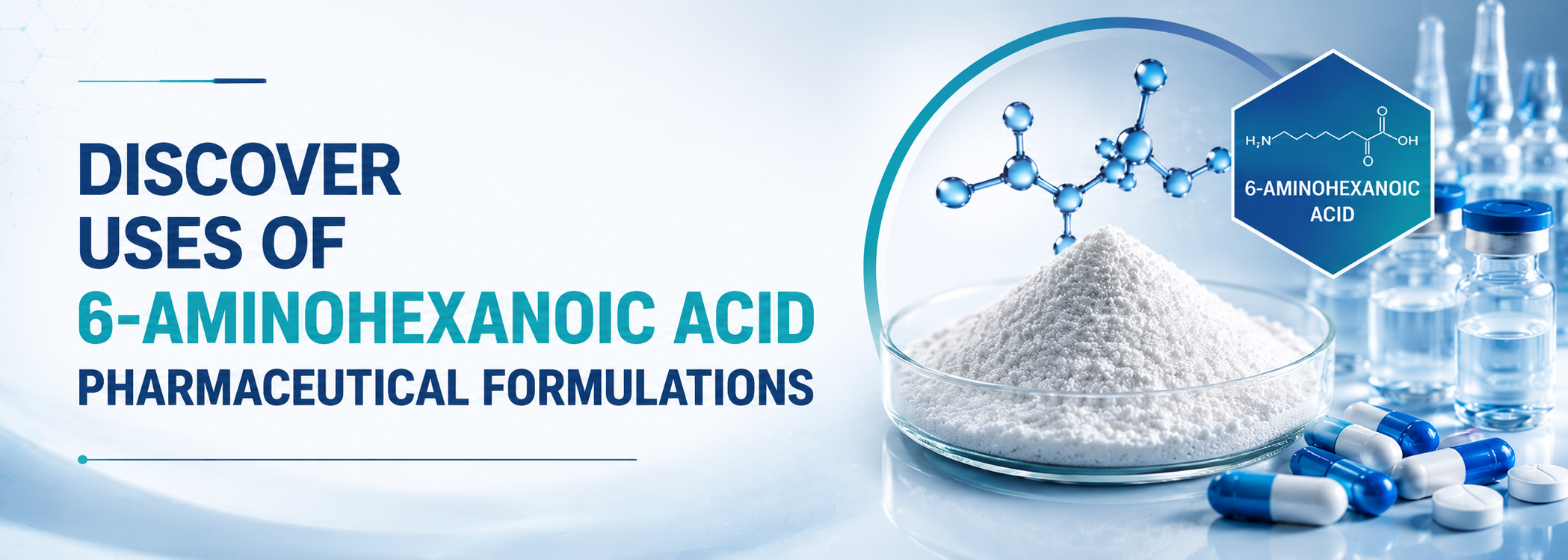
23-07-2026
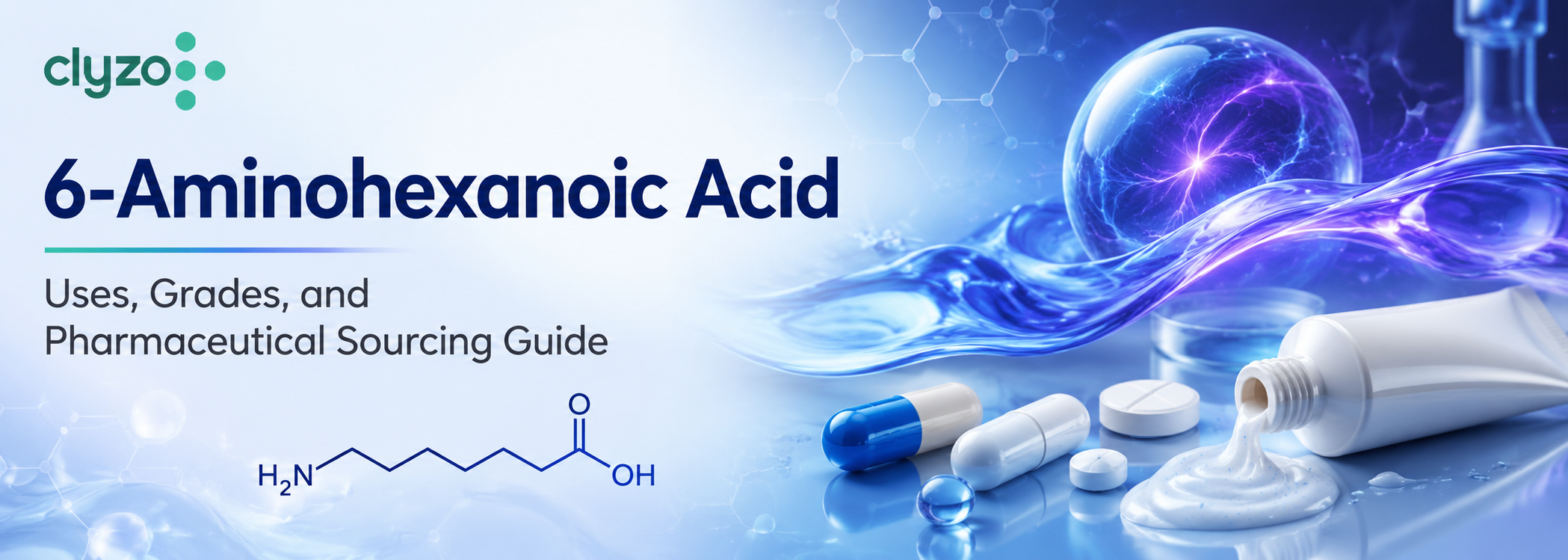
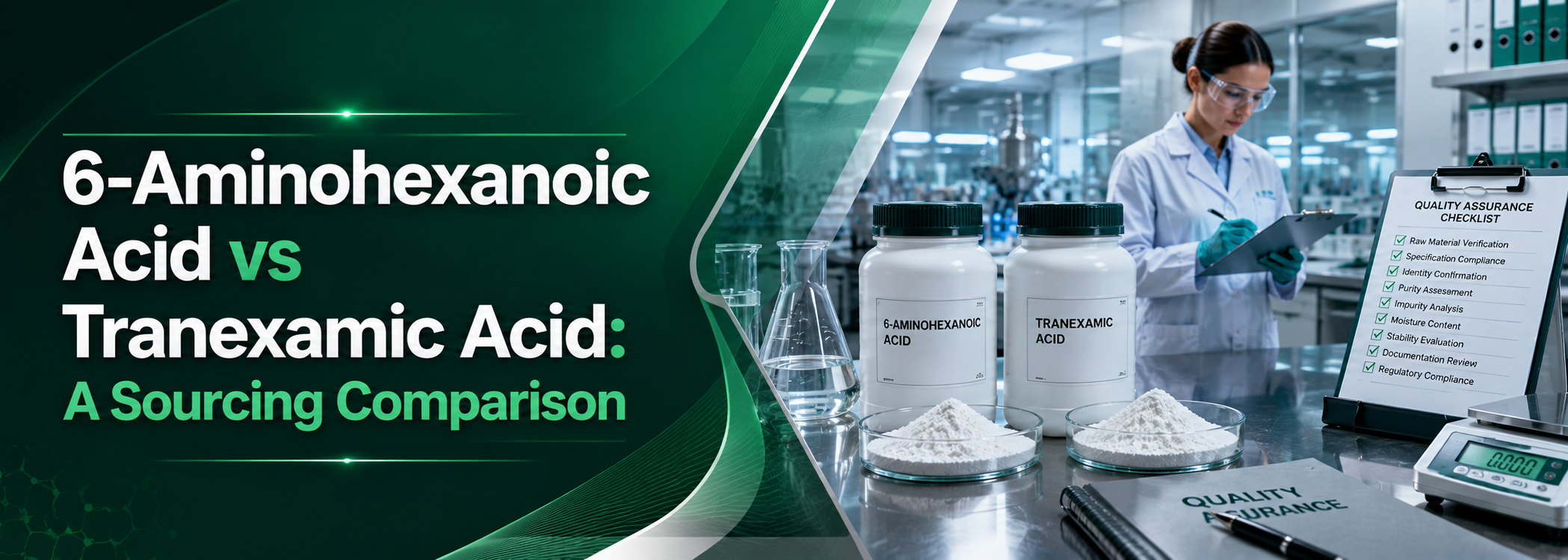
Quick answer: 6-Aminohexanoic acid (e-aminocaproic acid, EACA) has four main uses: as the active ingredient in antifibrinolytic medications that manage excessive bleeding, as a linker in peptide synthesis, as a precursor in nylon-6 polymer manufacturing, and as a research tool for studying enzyme and protein interactions. Each application requires a different material grade, so buyers should confirm which use case applies before sourcing.
6-Aminohexanoic acid shows up in pharmaceutical and chemical manufacturing in more than one role, which can create confusion for teams sourcing it for the first time. Understanding which application applies to your formulation and which grade that application requires — is the first step before requesting quotes from any supplier.
6-Aminohexanoic acid is best known as the active ingredient in antifibrinolytic medications used to control excessive bleeding, including in surgical settings and in patients with certain hematological disorders. In this context, it works by inhibiting the conversion of plasminogen to plasmin, which slows the enzymatic breakdown of blood clots (fibrinolysis) and helps stabilize clot formation where it's needed.
Because it functions as the active pharmaceutical ingredient (API) in these formulations rather than as an inactive excipient, manufacturers producing tablets, oral solutions, or injectable preparations need material meeting strict pharmacopoeial purity standards not simply "pharma grade" without a named monograph. Dosing and formulation decisions in this context are made by drug developers and regulatory bodies; from a sourcing perspective, what matters is that the raw material supports the assay, impurity, and stability specifications the finished product's regulatory filing requires.
Because of its flexible, hydrophobic hexanoic acid backbone, 6-Aminohexanoic acid along with protected derivatives such as Boc-6-aminohexanoic acid and Fmoc-6-aminohexanoic acid is widely used as a linker in solid-phase peptide synthesis. The protecting groups (Boc, Fmoc) allow selective deprotection during synthesis, which is essential when researchers need to build complex peptide sequences without unwanted side reactions.
This linker function helps stabilize peptide structures and is a common choice when researchers need a spacer between functional groups without introducing an additional reactive alpha-amino group into the chain. It's particularly relevant in the design of peptide-based therapeutics and bioconjugation chemistry, where the compound helps attach biomolecules to surfaces or to other molecules for diagnostic or targeted drug-delivery applications.
Outside the pharmaceutical space, 6-Aminohexanoic acid is also a known chemical precursor in nylon-6 fiber production, valued for the strength and flexibility it contributes to the finished polymer. This is a structurally separate supply chain from pharma-grade material different purity specifications, different manufacturing partners, and generally a different price point.
This is worth flagging explicitly because it's the most common source of confusion when sourcing the compound: a supplier quoting "6-Aminohexanoic acid" without specifying grade may be quoting industrial material that isn't suitable for pharmaceutical use, even though the chemical name is identical. Buyers should always confirm grade rather than assume it based on the compound name alone.
In research settings, 6-Aminohexanoic acid is used to study enzyme inhibition and protein interactions, given its structural similarity to lysine without the reactive alpha-amino group that would otherwise participate in unwanted side reactions. It also serves as a substrate in certain enzyme-catalyzed reaction studies, making it a useful tool in academic and industrial biochemistry labs exploring metabolic pathways and therapeutic targets.
| Application | Grade needed | Documentation to request |
| API for antifibrinolytic formulations | Pharmacopoeial (USP/EP/JP) | Full CoA, impurity profile, regulatory dossier support (DMF/CEP where applicable) |
| Peptide synthesis linker | Research/synthesis grade | Purity certificate, protecting group specification (Boc/Fmoc) |
| Polymer/nylon-6 precursor | Industrial grade | Technical data sheet |
| Lab research use | Reagent grade | Standard CoA |
Because the same compound name covers such different use cases, it's worth confirming with your supplier exactly which grade you're being quoted. The price and lead time can differ significantly between industrial-grade and pharmacopoeial-grade material, and mixing them up can cost time later in a project if the wrong grade shows up at the formulation or quality control stage.
It's worth understanding that demand for 6-Aminohexanoic acid isn't driven solely by pharmaceutical manufacturing. The polymer and peptide synthesis markets both create meaningful demand for the compound at different purity tiers, which means the overall supply chain is broader and in some ways more fragmented than for excipients used exclusively in pharma. This is useful context for procurement teams: it explains why grade clarity matters more here than it might for a compound with a single, narrow application.
Is 6-Aminohexanoic acid an excipient or an active ingredient?
It depends on the formulation. In antifibrinolytic drug products, it functions as the active pharmaceutical ingredient, not an inactive excipient. In other contexts such as peptide synthesis it acts more like a raw material or building block rather than either category in the traditional excipient sense.
What's the difference between 6-Aminohexanoic acid and its Boc- or Fmoc-protected forms?
The protected forms (Boc-6-aminohexanoic acid, Fmoc-6-aminohexanoic acid) carry a temporary protecting group used in peptide synthesis to control which reactive sites participate in a given coupling step. The unprotected form is used directly in pharmaceutical formulations and industrial applications.
Can pharma-grade material be used for peptide synthesis, or vice versa?
Generally not interchangeably without verification. Peptide synthesis grade material is typically evaluated for purity relevant to synthesis chemistry, while pharmacopoeial grade is tested against a specific monograph's impurity and assay limits. Always confirm the grade matches your intended use rather than assuming equivalence.
6-Aminohexanoic acid's value across pharmaceutical, peptide chemistry, and polymer manufacturing is exactly what makes sourcing it correctly a bit more involved than a single-use raw material. Identifying your specific application first and confirming the matching grade and documentation with your supplier avoids the most common sourcing mistake with this compound.
Sourcing pharma-grade 6-Aminohexanoic acid for a formulation project? Compare monograph-compliant options on Clyzo and request a sample with full documentation.
We’d love to hear from you. Please fill out this form.
Ethanol 99% Injectable Grade: USP, Ph.Eur., BP, JP... ... Ethanol 99% Injectable Grade: USP, Ph.Eur., BP, JP & GMP Guide | Clyzo Read more
Ethanol 96% Injectable Grade in India: USP, Ph.Eur... ... Ethanol 96% Injectable Grade in India: USP, Ph.Eur., BP, JP & GMP | Clyzo Read more
Pharma Grade Ethanol: A Complete Guide to Injectab... ... Pharma Grade Ethanol: A Complete Guide to Injectable, USP, Ph.Eur., BP and IPEC Grades Read more
Online Pharma Ingredient Sourcing: A Practical Gui... ... Online Pharma Ingredient Sourcing: A Practical Guide for Buyers Read more
Pharma Raw Material Supplier in India: How to Choo... ... Pharma Raw Material Supplier in India: How to Choose the Right One Read more
Digital Pharma Sourcing in India: How B2B Buyers A... ... Digital Pharma Sourcing in India: How B2B Buyers Are Changing the Way They Source Excipients Read more
.png)
PEG 400 (Polyethylene Glycol 400) Pharmaceutical S... ... PEG 400 (Polyethylene Glycol 400) Pharmaceutical Supplier in India: Complete Guide Read more
PEG 4000 (Polyethylene Glycol 4000) Pharmaceutical... ... PEG 4000 (Polyethylene Glycol 4000) Pharmaceutical Supplier in India: Complete Guide Read more
Chicken, Liver, and Meat Flavor Pharmaceutical Exc... ... Chicken, Liver, and Meat Flavor Pharmaceutical Excipients: The Backbone of Veterinary Medicine Compliance in India Read more
Polysorbate 80 Pharmaceutical Grade Supplier India... ... Polysorbate 80 Pharmaceutical Grade Supplier India: The Complete Sourcing Guide Read more
Polysorbate 80 Pharmaceutical Grade India: 10 Fact... ... Polysorbate 80 Pharmaceutical Grade India: 10 Facts Every Buyer Should Know Read more
PS 80 Excipient Supplier India: A 10 Point Buyer C... ... PS 80 Excipient Supplier India: A 10 Point Buyer Checklist Read more
Polysorbate 80 Injectable Grade Excipient: 10 Fact... ... Polysorbate 80 Injectable Grade Excipient: 10 Facts You Need to Know Read more
Polysorbate 80 USP NF Bulk Supplier: A 10 Point So... ... Polysorbate 80 USP NF Bulk Supplier: A 10 Point Sourcing Checklist Read more
Polysorbate 80 Pharmaceutical Grade India: What Bu... ... Polysorbate 80 Pharmaceutical Grade India: What Buyers Need to Know Read more
PS 80 Excipient Supplier India: How to Choose the ... ... PS 80 Excipient Supplier India: How to Choose the Right Partner Read more
Polysorbate 80 Injectable Grade Excipient: A Sourc... ... Polysorbate 80 Injectable Grade Excipient: A Sourcing Guide for Parenteral Formulations Read more
Polysorbate 80 USP NF Bulk Supplier: What to Know ... ... Polysorbate 80 USP NF Bulk Supplier: What to Know Before You Scale Up Read more
Top AMP-95 (Aminomethyl Propanol) Manufacturers an... ... Top AMP-95 (Aminomethyl Propanol) Manufacturers and Suppliers in India (2026 Guide) Read more
.jpg)
How AMP Works as a pH Buffer in Injectable, Ophtha... ... How AMP Works as a pH Buffer in Injectable, Ophthalmic, and Topical Formulations Read more
.jpg)
AMP vs Other Alkalizing Agents in Pharma Formulati... ... AMP vs Other Alkalizing Agents in Pharma Formulations: TRIS, Triethanolamine, and Sodium Hydroxide Compared Read more
AMP Excipient Safety: Toxicity, Irritation Potenti... ... AMP Excipient Safety: Toxicity, Irritation Potential, and Regulatory Status Read more
Chlorobutanol Preservative Safety: Toxicity Data, ... ... Chlorobutanol Preservative Safety: Toxicity Data, Regulatory Status, and Usage Limits Read more
Top Chlorobutanol Anhydrous Manufacturers and Supp... ... Top Chlorobutanol Anhydrous Manufacturers and Suppliers in India (2026 Guide) Read more
Chlorobutanol as a Preservative in Injectables, Ey... ... Chlorobutanol as a Preservative in Injectables, Eye Drops, and Nasal Sprays Read more
Chlorobutanol Anhydrous vs Hemihydrate: Which Grad... ... Chlorobutanol Anhydrous vs Hemihydrate: Which Grade Should You Choose? Read more
Chlorobutanol Anhydrous Pharmaceutical Excipient: ... ... Chlorobutanol Anhydrous Pharmaceutical Excipient: Uses, Grades, and Sourcing in India Read more
Benzyl Alcohol: A Pharmaceutical Excipient India S... ... Benzyl Alcohol: A Pharmaceutical Excipient India Supplier Guide for Preservative Sourcing Read more
Tyloxapol: A Specialized Pharmaceutical Excipient ... ... Tyloxapol: A Specialized Pharmaceutical Excipient Supplier in India Can Help You Source Correctly Read more
SLS (Sodium Lauryl Sulfate): A Complete Guide for ... ... SLS (Sodium Lauryl Sulfate): A Complete Guide for Pharma Excipient Buyers in India Read more
.jpg)
Polysorbate 80 (PS 80): The Pharmaceutical Excipie... ... Polysorbate 80 (PS 80): The Pharmaceutical Excipient Supplier India Trusts for Surfactant Applications Read more
Amine Fluoride 33%: Sourcing Guide for This Pharma... ... Amine Fluoride 33%: Sourcing Guide for This Pharmaceutical Excipient Supplier Ingredient Read more
How to Source Pharmacopoeial-Grade 6-Aminohexanoic... ... How to Source Pharmacopoeial-Grade 6-Aminohexanoic Acid Online in India Read more
6-Aminohexanoic Acid Specifications: What Buyers S... ... 6-Aminohexanoic Acid Specifications: What Buyers Should Check Before Purchase Read more
6-Aminohexanoic Acid Supplier in India: A Complete... ... 6-Aminohexanoic Acid Supplier in India: A Complete Sourcing Guide Read more
.png)
L-Arginine Hydrochloride Excipient Supplier in Ind... ... L-Arginine Hydrochloride Excipient Supplier in India Read more



.png)
.png)